Percentage Calculator
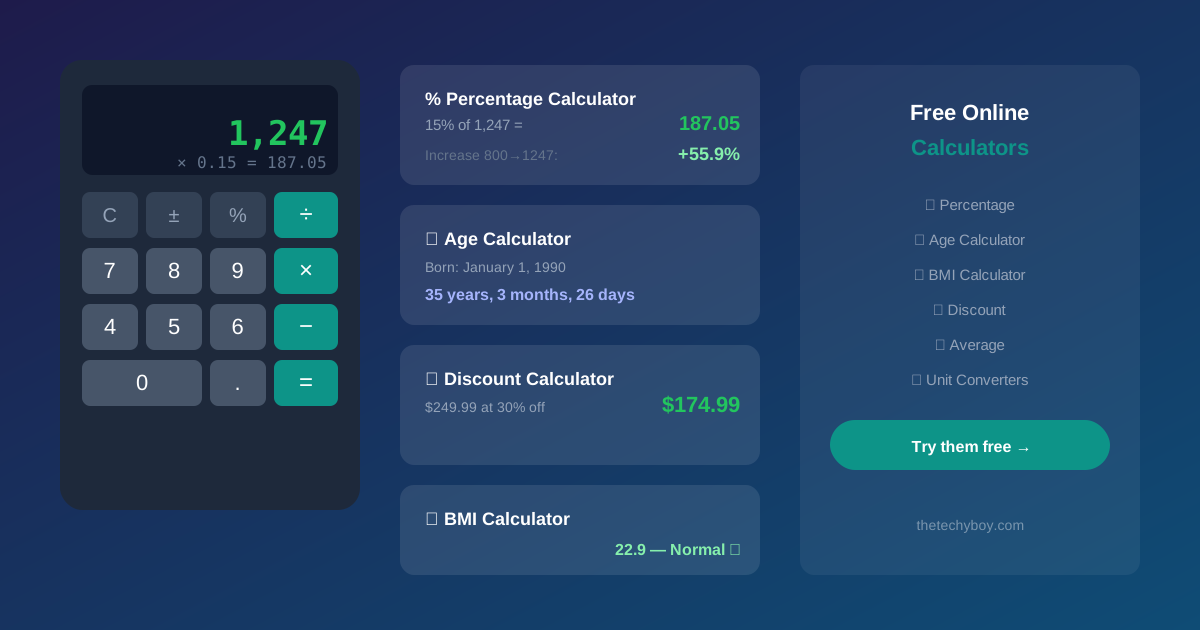
Our Percentage Calculator solves the three most common percentage problems instantly: finding what percentage X is of Y, calculating a percentage increase or decrease, and finding the original value before a percentage was applied. These calculations appear constantly in everyday life — calculating tips, discounts, exam scores, tax rates, profit margins, and investment returns.
The calculator presents three clearly labeled modes so you can pick the exact calculation you need without confusion. Each mode shows the formula being used so you can understand the math and apply it yourself in future.
Calculation Modes
- What is X% of Y? — e.g., "What is 15% of $85?" → $12.75
- X is what percent of Y? — e.g., "42 is what percent of 200?" → 21%
- Percentage change — e.g., "Increase from $50 to $65" → 30% increase
- Find original value — e.g., "After 20% discount, price is $80. What was the original?" → $100
- Add or remove percentage — e.g., "Add 8% tax to $120" → $129.60
- Formula display — shows the mathematical formula used for each calculation.
How to Calculate a Percentage
- Select the calculation mode that matches your question.
- Enter the known values in the input fields.
- Click Calculate.
- The result and the formula used are displayed immediately.
- Click Reset to start a new calculation.
Common Percentage Formulas
Find percentage: (Part ÷ Whole) × 100. Example: (30 ÷ 150) × 100 = 20%. Find value from percentage: (Percentage ÷ 100) × Whole. Example: (25 ÷ 100) × 80 = 20. Percentage increase: ((New − Old) ÷ Old) × 100. Example: ((120 − 100) ÷ 100) × 100 = 20% increase. Percentage decrease: ((Old − New) ÷ Old) × 100. Example: ((100 − 80) ÷ 100) × 100 = 20% decrease. Find original before percentage: Final ÷ (1 + Rate/100). Example: 120 ÷ 1.20 = $100 original.
Frequently Asked Questions
What is the difference between percentage and percentage points?
A percentage expresses a ratio. A percentage point is the arithmetic difference between two percentages. If interest rates rise from 3% to 5%, that is a 2 percentage point increase, but a 66.7% increase in the rate itself. This distinction is important in finance and statistics.
How do I calculate a tip?
Multiply the bill by the tip percentage divided by 100. For a 20% tip on a $45 bill: 45 × (20/100) = $9 tip. Total = $54.
How do I calculate a discount?
Multiply the original price by (1 − discount rate). For 30% off $80: 80 × (1 − 0.30) = 80 × 0.70 = $56. Use our Discount Calculator for more detailed discount calculations.
How do I calculate percentage change?
((New Value − Old Value) ÷ Old Value) × 100. A positive result is an increase, negative is a decrease.



Popular Tools
Recent Posts